DonateMembershipVisit Heritage
  • Tūrangawaewae
    Places
  • Tira Māori
    Māori Heritage
  • Poutairangahia
    Archaeology
  • Rauemi
    Resources
  • Mō Tātou
    About Us
  • New Zealand Heritage List
  • Nominate and submit
  • Explore the List
  • National Historic Landmarks
  • Plaques
  • Rainbow List Project
  • Lost heritage
  • Visit Heritage
  • Our properties
  • Turnbull House Project
  • Collections
  • Shop
  • Tohu Whenua
  • Tira Māori
  • Conserving Māori heritage
  • Marae built heritage
  • Māori heritage on the List
  • Hinemihi—Te Hokinga Mai
  • What is archaeology?
  • Is there a site on my property?
  • What are my legal requirements?
  • Affecting an archaeological site
  • Declaring an archaeological site
  • Archaeology FAQs
  • Archaeology Digital Library
  • Archaeology guidelines and templates
  • Resources
  • Funding
  • Publications
  • Sustainable management guides
  • Disaster recovery
  • Podcasts & digital resources
  • Education Hub
  • Conservation plans
  • About
  • Board
  • Māori Heritage Council
  • Senior Staff
  • Offices
  • Contact us
  • Careers
  • Covenants
  • Fast-track
  • Corporate documents
  • Currently consulting on
  • Our submissions
  • News
  • Covid-19 response
Quick links
Rārangi Kōrero | The List
Explore the List
National Historic Landmarks
Ngā Manawhenua o Aotearoa me ōna Kōrero Tūturu
Quick links
Tapuwae
A Vision for Places of Māori Heritage
Funding for Māori Heritage
Resources
Quick links
Archaeological Authority Portal
Applying for an archaeological authority
Archaeology FAQs
Browse the most frequently asked questions about archaeological authorities and the archaeological process.
Quick links
Quick links
News
News Keep up to date with Heritage New Zealand Pouhere Taonga
Membership
Membership Find out more and sign up today
DonateMembershipVisit Heritage
  • Tūrangawaewae
    Places
  • Tira Māori
    Māori Heritage
  • Poutairangahia
    Archaeology
  • Rauemi
    Resources
  • Mō Tātou
    About Us
  • New Zealand Heritage List
  • Nominate and submit
  • Explore the List
  • National Historic Landmarks
  • Plaques
  • Rainbow List Project
  • Lost heritage
  • Visit Heritage
  • Our properties
  • Turnbull House Project
  • Collections
  • Shop
  • Tohu Whenua
  • Tira Māori
  • Conserving Māori heritage
  • Marae built heritage
  • Māori heritage on the List
  • Hinemihi—Te Hokinga Mai
  • What is archaeology?
  • Is there a site on my property?
  • What are my legal requirements?
  • Affecting an archaeological site
  • Declaring an archaeological site
  • Archaeology FAQs
  • Archaeology Digital Library
  • Archaeology guidelines and templates
  • Resources
  • Funding
  • Publications
  • Sustainable management guides
  • Disaster recovery
  • Podcasts & digital resources
  • Education Hub
  • Conservation plans
  • About
  • Board
  • Māori Heritage Council
  • Senior Staff
  • Offices
  • Contact us
  • Careers
  • Covenants
  • Fast-track
  • Corporate documents
  • Currently consulting on
  • Our submissions
  • News
  • Covid-19 response
Quick links
Rārangi Kōrero | The List
Explore the List
National Historic Landmarks
Ngā Manawhenua o Aotearoa me ōna Kōrero Tūturu
Quick links
Tapuwae
A Vision for Places of Māori Heritage
Funding for Māori Heritage
Resources
Quick links
Archaeological Authority Portal
Applying for an archaeological authority
Archaeology FAQs
Browse the most frequently asked questions about archaeological authorities and the archaeological process.
Quick links
Quick links
News
News Keep up to date with Heritage New Zealand Pouhere Taonga
Membership
Membership Find out more and sign up today
  • Nominate and submit
  • National Historic Landmarks
  • Nominate and submit
  • National Historic Landmarks
  • Conserving Māori heritage
  • Marae built heritage
  • Conserving Māori heritage
  • Marae built heritage
  • Archaeological authorities
  • Archaeology Digital Library
  • Archaeological authorities
  • Archaeology Digital Library
  • All resources
  • Publications
  • Funding
  • All resources
  • Publications
  • Funding
  • FAQs
  • FAQs
Follow us on:
Places
  • Nominate and submit
  • National Historic Landmarks
Tira Māori
  • Conserving Māori heritage
  • Marae built heritage
Archaeology
  • Archaeological authorities
  • Archaeology Digital Library
Resources
  • All resources
  • Publications
  • Funding
FAQs
  • FAQs
Follow us on
HomePrivacyTerms and conditionsAbout this site
© Heritage New Zealand Pouhere Taonga 2026.
 
Pumping Station (Former)

805 Great North Road, Museum of Transport and Technology, Western Springs, AUCKLAND

Public

Historic Place Category 1

List No. 114

Quick links:
List GalleryLocationDetails
Pumping Station (Former), Museum of Transport and Technology, Auckland | NZ Historic Places Trust

List Entry Information

Overview

Status
Listed

List Entry Status
Historic Place Category 1

Access
Able to Visit

List Number
114

Date Entered
2nd July 1987

Date of Effect
2nd July 1987

City/District Council
Auckland Council

Region
Auckland Council

Legal description

Lot 1 DP 88398 (RT NA45D/561), North Auckland Land District

Detailed List Entry
Significance

Historic Significance

Historical Significance or Value The Western Springs waterworks, of which the pump station is a remnant, was constructed for the Auckland City Council on land formerly owned by the flour-milling firm of Low and Motion. The contract was let in 1875 to T and S Morrin and the pumphouse opened on 10 July 1877. Until 1902, when reticulation began from the Waitakere Ranges, water pumped by the stream-driven beam engine housed in the building provided the public supply for Auckland city and several adjacent local authorities, The pumphouse is therefore a structure of considerable regional historical importance.

Physical Significance

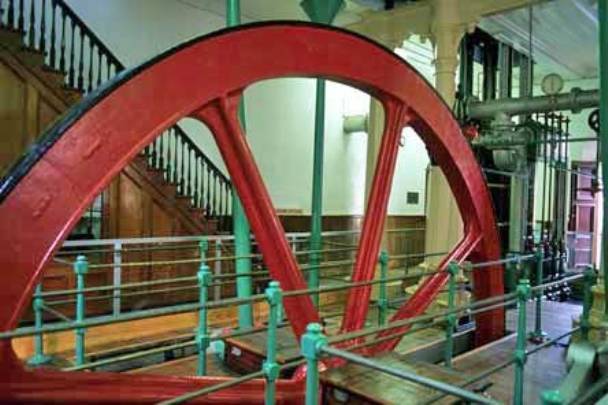
ARCHITECTURAL SIGNIFICANCE The pumphouse is one of the most impressive examples of Victorian industrial architecture in New Zealand. The building comprises some very fine brick and stone detailing which contributes to the building's fine texture. The interior of the building is especially impressive with its simplified Doric columns and beams. The pumping machinery is the finest in New Zealand still intact. Its most notable features are the large beam engine and cast-iron flywheel (6.2 metres in diameter). TOWNSCAPE/LANDMARK SIGNIFICANCE The pumphouse forms the centrepiece at the Museum of Transport and Technology (MOTAT) and although somewhat boxed in by surrounding museum structures it remains visually, a very impressive structure. SPECIAL FEATURES All the internal machinery and construction details, and on the exterior, high quality brick and stonework.

Construction Professional

Name

Errington, William

Type

Engineer

Biography

William Errington was a distinguished engineer who designed the Big Pump at Thames in 1871 and the Calliope Dock at Devonport Naval Base in 1888, the largest graving dock in the southern hemisphere.

Construction Details

Start Year

1875

Type

Original Construction

Construction Materials

Brick, with cast iron columns and timber panelled ceiling in the interior.

Physical Description

ARCHITECTURAL DESCRIPTION (STYLE) The building consists of a square two-storeyed block with a single storey wing attached. The two storey block has rusticated quoins, round-arched windows and cornice. Large archways are the main feature of the single storey section. MODIFICATIONS The building is in largely original condition.

Reference

Information Sources

Thornton, 1982

Geoffrey G. Thornton, New Zealand's Industrial Heritage, A.H. & A.W. Reed, Wellington, 1982

Report Written By

This historic place was registered under the Historic Places Act 1980. This report includes the text from the original Building Classification Committee report considered by the NZHPT Board at the time of registration. Please note that entry on the New Zealand Heritage List/Rarangi Korero identifies only the heritage values of the property concerned, and should not be construed as advice on the state of the property, or as a comment of its soundness or safety, including in regard to earthquake risk, safety in the event of fire, or insanitary conditions.

Further Information

Current Usages

Uses: Civic Facilities

Specific Usage: Museum

Former Usages

General Usage:: Civic Facilities

Specific Usage: Museum

Themes

Web Links

description: Engineering NZ Heritage

url: https://www.engineeringnz.org/our-work/heritage/heritage-records/western-springs-pumping-station/

Overview

Status

Listed

List Entry Status

Historic Place Category 1

Access

Able to Visit

List Number

114

Date Entered

2nd July 1987

Date of Effect

2nd July 1987

City/District Council

Auckland Council

Region

Auckland Council

Legal description

Lot 1 DP 88398 (RT NA45D/561), North Auckland Land District

Status

Listed

List Entry Status

Historic Place Category 1

Access

Able to Visit

List Number

114

Date Entered

2nd July 1987

Date of Effect

2nd July 1987

City/District Council

Auckland Council

Region

Auckland Council

Legal description

Lot 1 DP 88398 (RT NA45D/561), North Auckland Land District

Significance

Why is this place significant?

Historic Significance

Historical Significance or Value The Western Springs waterworks, of which the pump station is a remnant, was constructed for the Auckland City Council on land formerly owned by the flour-milling firm of Low and Motion. The contract was let in 1875 to T and S Morrin and the pumphouse opened on 10 July 1877. Until 1902, when reticulation began from the Waitakere Ranges, water pumped by the stream-driven beam engine housed in the building provided the public supply for Auckland city and several adjacent local authorities, The pumphouse is therefore a structure of considerable regional historical importance.

Physical Significance

ARCHITECTURAL SIGNIFICANCE The pumphouse is one of the most impressive examples of Victorian industrial architecture in New Zealand. The building comprises some very fine brick and stone detailing which contributes to the building's fine texture. The interior of the building is especially impressive with its simplified Doric columns and beams. The pumping machinery is the finest in New Zealand still intact. Its most notable features are the large beam engine and cast-iron flywheel (6.2 metres in diameter). TOWNSCAPE/LANDMARK SIGNIFICANCE The pumphouse forms the centrepiece at the Museum of Transport and Technology (MOTAT) and although somewhat boxed in by surrounding museum structures it remains visually, a very impressive structure. SPECIAL FEATURES All the internal machinery and construction details, and on the exterior, high quality brick and stonework.

Why is this place significant?

Historic Significance

Historical Significance or Value The Western Springs waterworks, of which the pump station is a remnant, was constructed for the Auckland City Council on land formerly owned by the flour-milling firm of Low and Motion. The contract was let in 1875 to T and S Morrin and the pumphouse opened on 10 July 1877. Until 1902, when reticulation began from the Waitakere Ranges, water pumped by the stream-driven beam engine housed in the building provided the public supply for Auckland city and several adjacent local authorities, The pumphouse is therefore a structure of considerable regional historical importance.

Physical Significance

ARCHITECTURAL SIGNIFICANCE The pumphouse is one of the most impressive examples of Victorian industrial architecture in New Zealand. The building comprises some very fine brick and stone detailing which contributes to the building's fine texture. The interior of the building is especially impressive with its simplified Doric columns and beams. The pumping machinery is the finest in New Zealand still intact. Its most notable features are the large beam engine and cast-iron flywheel (6.2 metres in diameter). TOWNSCAPE/LANDMARK SIGNIFICANCE The pumphouse forms the centrepiece at the Museum of Transport and Technology (MOTAT) and although somewhat boxed in by surrounding museum structures it remains visually, a very impressive structure. SPECIAL FEATURES All the internal machinery and construction details, and on the exterior, high quality brick and stonework.

Construction Information

Construction Professional

Name

Errington, William

Type

Engineer

Biography

William Errington was a distinguished engineer who designed the Big Pump at Thames in 1871 and the Calliope Dock at Devonport Naval Base in 1888, the largest graving dock in the southern hemisphere.

Construction Details

Start Year

1875

Type

Original Construction

Construction Materials

Brick, with cast iron columns and timber panelled ceiling in the interior.

Construction Professional

Name

Errington, William

Type

Engineer

Biography

William Errington was a distinguished engineer who designed the Big Pump at Thames in 1871 and the Calliope Dock at Devonport Naval Base in 1888, the largest graving dock in the southern hemisphere.

Construction Details

Start Year

1875

Type

Original Construction

Construction Materials

Brick, with cast iron columns and timber panelled ceiling in the interior.

Physical Description

ARCHITECTURAL DESCRIPTION (STYLE) The building consists of a square two-storeyed block with a single storey wing attached. The two storey block has rusticated quoins, round-arched windows and cornice. Large archways are the main feature of the single storey section. MODIFICATIONS The building is in largely original condition.

ARCHITECTURAL DESCRIPTION (STYLE) The building consists of a square two-storeyed block with a single storey wing attached. The two storey block has rusticated quoins, round-arched windows and cornice. Large archways are the main feature of the single storey section. MODIFICATIONS The building is in largely original condition.

Reference

Historical and Associated Iwi / Hapū / Whānau

Information Sources

Thornton, 1982

Geoffrey G. Thornton, New Zealand's Industrial Heritage, A.H. & A.W. Reed, Wellington, 1982

Other Information

This historic place was registered under the Historic Places Act 1980. This report includes the text from the original Building Classification Committee report considered by the NZHPT Board at the time of registration. Please note that entry on the New Zealand Heritage List/Rarangi Korero identifies only the heritage values of the property concerned, and should not be construed as advice on the state of the property, or as a comment of its soundness or safety, including in regard to earthquake risk, safety in the event of fire, or insanitary conditions.

Historical and Associated Iwi / Hapū / Whānau

Information Sources

Thornton, 1982

Geoffrey G. Thornton, New Zealand's Industrial Heritage, A.H. & A.W. Reed, Wellington, 1982

Other Information

This historic place was registered under the Historic Places Act 1980. This report includes the text from the original Building Classification Committee report considered by the NZHPT Board at the time of registration. Please note that entry on the New Zealand Heritage List/Rarangi Korero identifies only the heritage values of the property concerned, and should not be construed as advice on the state of the property, or as a comment of its soundness or safety, including in regard to earthquake risk, safety in the event of fire, or insanitary conditions.

Further Information

Current Usages

Uses: Civic Facilities

Specific Usage: Museum

Former Usages

General Usage: Civic Facilities

Specific Usage: Museum

Web Links

description: Engineering NZ Heritage

url: https://www.engineeringnz.org/our-work/heritage/heritage-records/western-springs-pumping-station/

Current Usages

Uses: Civic Facilities

Specific Usage: Museum

Former Usages

General Usage: Civic Facilities

Specific Usage: Museum

Web Links

description: Engineering NZ Heritage

url: https://www.engineeringnz.org/our-work/heritage/heritage-records/western-springs-pumping-station/

Location

Loading
Stay up to date with Heritage this month